
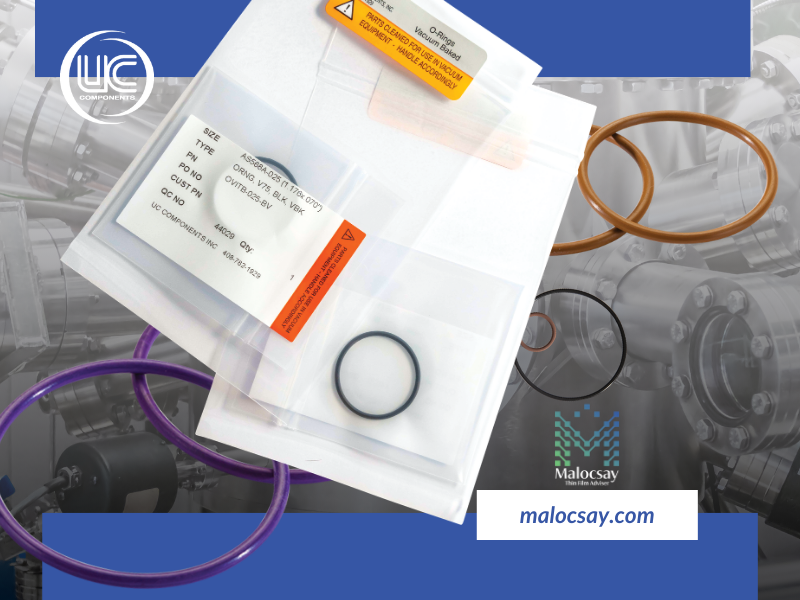
Reposted with permission from UC Components, Inc. View the original post on their site here: https://www.uccomponents.com/material-considerations-for-o-rings-used-in-vacuum-and-clean-critical-environments/
O-rings are most often the primary source of contamination in any vacuum system. Selecting the proper O-ring design and material are essential to maintaining the seal and overall system integrity. Unfortunately, you cannot simply rely on the property values you get for the elastomers when selecting an O-ring for your clean-critical application; vacuum performance of the material can differ strongly from supplier to supplier, as well as batch to batch.
Why is the material so important?
The key factors to look at in material selection for your O-rings include:
- Permeability
- Surface contamination
- Outgassing from the compound
- Chemical compatibility
Permeability
All elastomers have some permeability to gases. Each polymer has a different permeation rate to different gasses which is also affected by the temperature of the environment. Permeability, or permeation, of gasses through an O-ring differ greatly based on the material, hardness, temperature, thickness of the O-ring, overall size of the O-ring, pressure, lubrication, and type of gas. The most common O-ring material for vacuum applications is FKM Viton® A or a similar fluoroelastomer. Please note that not all of the O-ring materials listed below are necessarily suitable for vacuum service.
Permeation (10-8 sccm, cm/sec, cm2, atm):
| MATERIAL | HE | H2 | H2O | N2 | CO2 |
| Buna-N | 8 | 2.5 | 760 | 0.1 | 25 |
| EPDM | 25-30 | 16-18 | – | 6-7 | 85 |
| Fluorosilicone | 140 | 80 | – | 40 | 400 |
| FKM Viton® A | 9-22 | 1-2 | 40 | 0.05-0.7 | 5 |
| FKM Viton® GF | 30 | 3 | – | 2 | – |
| KEL-F | – | 0.1 | 0.1 | 0.5 | |
| Markez® FFKM | 60-80 | 6-8 | 90-100 | 8-12 | – |
| PTFE | – | 0.4 | – | 0.14 | 0.12 |
| Polyimide | 1.9 | 0.1 | – | 0.3 | 0.2 |
| Silicone | 250 | 75-450 | 8,000 | 200 | 2,000 |
Surface Contamination
During the manufacturing process a number of factors can affect the surface quality of the finished O-ring produced including factory temperature and humidity, the age and finish of the O-ring molds, mold lubricants and/or mold release powder, curing, flashing or residual seam presence, storage, handling, and packaging. Each of these factors can contribute to what is typically a very dirty O-ring.
The UC Components, Inc. RediVac® process addresses raw O-ring quality via individual inspection, executes a process for surface contamination removal, and can take it to the next level with vacuum bake-out to remove water vapor and some volatile organics. The RediVac® process concludes with proper handling and packaging and can be accompanied by additional processing documentation upon request.
Outgassing
An unprocessed, or “raw”, O-ring will contain a great deal of water which is chemically formed during the manufacturing process. Additional solvents and plasticizers with low vapor pressures will also likely be present. These contaminants will gradually come to the surface, desorb (outgass), and be pumped-away as a gas. The higher the load the longer this will take and the potential for process contamination will grow. Outgassing is a common problem when creating, or maintaining, a clean high-vacuum environment. High-vacuum environments, as well as high temperatures, increase the rate of outgassing due to vapor pressure and an increase in chemical reactions.
Proper processing is key to turning a basic, widely available, generally inexpensive raw O-ring into a tool that can safely be deployed in a vacuum process. One of the best ways to help reduce outgassing is the use of specifically formulated and treated O-ring installation – cleaned or vacuum baked O-rings. UC Components provides this critical processing.